Friday, December 18, 2015

FDA’s AquaAdvantage approval - Understand the law, evaluate the politics of policy change (Michaela Oldfield)

FDA’s AquaAdvantage approval

Understand the law, evaluate the politics of policy change
By Michaela Oldfield

Several weeks ago, the FDA released its approval of AquaAdvantage salmon. Food and ag lawyers at other blogs quickly jumped in with analyses and further information on the action.

For our students, I want to highlight several components of the approval that I think they should understand and examine. The goal with this post is to highlight the sources of law governing FDA’s action and provide a brief explanation of the legal rationale that produced the outcome.

First, the Approval is for AquaAdvantage as a new animal drug - this makes it a different procedure than what commercially available GE Crops have gone through. Here’s a little chart summarizing the differences:

Agency
GE Crops
GE Salmon
FDA  
Considered “substantially equivalent” to non-GE crops; manufacturers may voluntarily request FDA review of GRAS determination
new drug approval
EPA  
Review as a pesticide if the plant is engineered to endogenously produce a pesticide
n/a
USDA
APHIS review of plant pest risk
n/a
FWS
generally N/A, unless potential to impact endangered species
Section 7 ESA consultation with FDA because of potential impact on endangered Atlantic salmon

The GE salmon is being approved through the NADA process because the gene expression therapy qualifies as a drug under 201(g)(1)(C) of FDCA, which defines a drug as “articles (other than food) intended to affect the structure or any function of the body of man or other animals”.

In class, a teacher might ask if can you construct a legal argument that the salmon should be approved as a food or an additive, rather than a drug? In the world of food and drug law, this is an important argument to be able to make because the distinctions between a food, a drug, and an additive are high-stakes issues due to the differences in the regulatory regime for each item.

To make your argument, you need to start with the definitions in the law, which are codified at 21 U.S.C. 321:
  • (f) The term “food” means (1) articles used for food or drink for man or other animals, (2) chewing gum, and (3) articles used for components of any such article.
  • (g)(1) The term “drug” means ...(C) articles (other than food) intended to affect the structure or any function of the body of man or other animals

With those definitions alone you can’t distinguish between a food and a drug. So you then need to go to case law to see how the courts interpret and apply that distinction.

A seminal case distinguishing a food from a drug is Nutrilab, Inc. v. Schweiker, 713 F.2d 335 (1983), in which starch blockers derived from beans were determined to be a drug because they “were not consumed primarily for taste, aroma, or nutritive value.” (This is only one case being given as an example - if you want to convince a judge, you would need a lot more than this!). So the rDNA technology affects the structure and function of the fish, and it's not being consumed for taste, aroma, or nutritive value and so it's arguably not a food.

But is there an argument the new gene it creates in the salmon is a food additive? In 21 USC 321(s) the term “food additive” means any substance the intended use of which results or may reasonably be expected to result, directly or indirectly, in its becoming a component or otherwise affecting the characteristics of any food.
Food and Water Watch tried to argue the salmon should be reviewed as a food additive and denied approval as not “generally recognized as safe” (GRAS) because the “process significantly alters the salmon’s composition... in a way that is reasonably expected to alter its nutritive value or concentration of constituents, and the new substance raises safety concerns.” Citizen Petition To Deem AquaBounty Technologies’ Genetically Engineered AquAdvantage Salmon An Unsafe Food Additive, p 2.

By the FDA’s regulation, if a food that is commonly consumed for its nutritive value “has had significant alteration of composition by breeding or selection...where the change may be reasonably expected to alter the nutritive value or the concentration of constituents” it must be “reviewed as and affirmed as GRAS or determined to be a food additive . . . .”21 C.F.R. § 170.30(f)(2) (2014).

FDA rejected FWW’s argument on the grounds that the salmon can not be approved as a drug and a food additive, and must necessarily undergo the drug approval process. Further, as part of the safety evaluation for the approval of a new animal drug, the FDA must evaluate the potential risks of “any substance formed in or on food because of the use of [the] drug” 21 U.S.C. 360b(d)(2)(a). FDA evaluated the salmon and the Gene Expression Product that resulted from use of the rDNA technology, and found AquaAdvantage salmon are as safe to eat as conventional salmon. FDA used this analysis as part of its justification for rejecting FWW’s petition to have the salmon declared an unsafe adulterant.

In addition to the FDCA, FDA’s approval process is also subject to requirements under the National Environmental Procedure Act (NEPA) and Endangered Species Act (ESA). As required by their regulations, the FDA produced an environmental assessment (EA) of the likely impacts of the approval, and reached a Finding of No Significant Impact (FONSI).

Accompanying the EA, the FDA also carried out a Section 7 ESA consultation with relevant federal agencies (see pages 9-10 and 135-136 of EA).  In short, the company will be breeding sterile stock in conditions that, if they escaped, they would die, and then transporting and raising them in Panama where they would also be expected to die if they escaped. As a result of the FONSI, the agency does not have to prepare a full Environmental Impact Statement.  

Some might not think of NEPA or the ESA as “food laws,” because on their face they appear to be environmental laws. However, they are important components of administrative law to know of because they are far-reaching statutes that can significantly slow down, stop, or force repeal of agencies’ actions.

Students should note, the approval is only for production of the salmon under very specific conditions. If anyone wants to breed or raise the salmon in any other locale or method than FDA approved here, they would have to go through the NADA approval process again.

In addition to analyzing what the law is and how it works, lawyers and policy wonks ought to also talk about what goals or purpose the law should serve and whether and how it needs to be changed to achieve that goal.

One way to think about this is to ask, does the current approval process for GE foods properly balance risks and benefits? Factors one might want to consider are:
  • What are the major environment and health concerns and what data is needed to evaluate those concerns?
  • What would be the time and financial cost of collecting and analyzing data to support review? Are those costs worth it given the risks?
  • Who should be collecting and reviewing the data?
  • Is there adequate opportunity for all stakeholders’ input?
  • How will risks and benefits be distributed?

A hot botton issue related to the GE salmon approval is the labelling of GE foods. Accompanying the AquaAdvantage approval, FDA also issued final guidance on labelling foods derived from GE technologies and draft guidance on labelling Salmon.  

As you surely know, there are also several other labelling law issues pending across the country. Vermont’s legislation on the mandatory labelling of GE foods is facing a federal court challenge; a number of consumer class actions on ‘natural’ labelled GE foods are in state courts; FDA recently solicited comments on the use of the term natural in labelling GE foods (more on that in my next post); and the appropriations bill that Congress just released did not contain a hotly contested rider to preempt state GE labelling laws.

Are FDA’s voluntary labelling guidelines sufficient to overcome any issues raised by the earlier questions? If not, what kind of law or policy would be more effective? Why, and what are the possible implications of those alternative laws? For instance, Vermont's legislation raises the spectre of patchwork legislation that undermines the national uniformity of FDA labelling rules. This issue, and whether Vermont’s law is even legal, is an issue I will come back to in a few weeks with a post on some recent food law preemption cases.

* * *

If you would like to delve into the approval and regulations, the online GFLP offers two courses on biotech regulations: 810P Biotechnology Law and Food Products (2 credits) and 810N Survey of Intellectual Property in Agriculture (3 credits).

Tuesday, November 17, 2015

A forum for thoughts on food law -- past, present and future


Welcome!

My name is Michaela Oldfield, I am the Global Food Law research fellow with the Michigan State University Global Food Law program. This blog is a place for GFL faculty and students and the Institute for Food Laws and Regulations (IFLR) faculty and students to share thoughts and ideas on food law issues.

Michaela Oldfield
The goal of this blog is to have a space for students and alums of the program to expand their education on global food law by providing a forum for summaries and thoughtful critiques of current food law issues and materials being covered in the courses.

Most posts will be authored by me or by Neal Fortin, whom many of you already know as the Director of the Institute for Food Laws and Regulations (IFLR) and Global Food Law programs at Michigan State University. However, occasionally there will be guest posts from faculty, affiliates and students within the program. If you are a student or alum of the program -- and have thoughts to share -- please contact communications manager Mark Meyer (meyerm18@anr.msu.edu) to discuss content.

As a new face to the program, I think a little background on me is in order. I have a J.D. from the University of Michigan and a Ph.D. from Michigan State in the Department of Community, Agriculture, Recreation and Resource Studies[1]. My dissertation research was on the Food Safety Modernization Act, [2] but my interests cover a range of regulatory issues from field to fork to waste.

I like spending my time thinking about how to design, adopt and implement regulations that balance the diversity of interests affected by food and agriculture policy (without being captured too much by special interests) and are flexible and dynamic to the constantly changing world around us (but without being dysfunctionally unpredictable).

Luckily, that is much of what I will be doing here! Being the Global Food Law Research Fellow means I get to interact with food professionals, lawyers, academics and government officials to identify, understand and help educate people on the numerous ways food law and policy is evolving and impacting globalized agri-food systems.

You’ll be seeing a broad array of issues in my blog posts, beginning with my first post which will examine the FDA's recent re-opening of the ‘natural’ can of worms and the history, law, and politics of labelling law and food production. I might then turn to law’s role in individual health and the economic, social, and environmental impacts of fruits and vegetables (i.e. FDA’s produce rule!) with maybe some Farm Bill 101  thrown in because I see them as intimately interrelated. Or I might explore how taking jurisprudence relates to agricultural risk, economic equity, public health and food security. Or, you know, whatever other issue piques my fancy that week.

So sit back and enjoy because it promises to be a Candyland kind of adventure (I leave it to you to decide which characters and places in the game are most analogous).


[1] The department’s name is now Community Sustainability.
[2] The short version of it is that the government agencies (specifically the FDA in my case) struggle to regulate global supply chains and dynamic markets.  At the same time, private actors such as NGOs and businesses have developed systems of private regulation which often involve standards for production practices and product quality, third party audits, and certifications – in short, this is private regulation that replicates, replaces, competes with, and augments government regulation. Learning about private regulation led me to ask questions about how do public and private actors and regimes interact to regulate food systems, with what consequences, and what should we do about it? For my dissertation, I used the FSMA as a case study for examining food safety governance in the United States, but  these systems of private and public-private regulation also cover many other food issues (such as organics and labor production) and occur in many other policy domains, such as fisheries and forestry management and corporate social responsibility.

Saturday, November 07, 2015

New Online Halal Food Law Course at Michigan State University


New online course in halal food with Michigan State University College of Law.

Online Master's in Global Food Law.
Get the tools you need to succeed in the food industry. 

Intro to halal food with Umar Moghul starts January 11, 2016.

Umar Moghul is a transactional lawyer and Lecturer in Law. His course introduces students to the religious foundations of Islamic dietary laws, ethics and customs as they relate to consumption and to commercial food production. He will also address discreet topics such as alcohol, gelatin, halal certification, and consideration of kosher laws and practices.
 
Earn a Master's Degree in Global Food Law.
Now accepting applications for Spring Semester 2016.
Apply 
online by November 15, 2015.


Visit globalfood.law.msu.edu for full program information.

Attorneys and other food industry professionals study together in the Master of Laws and Master of Jurisprudence program. Our students earn their graduate degree while maintaining careers at top food companies across the country and around the globe.
  • Atlanta Cheesecake Co.
  • Barilla Group
  • Bayer
  • Clif Bar
  • Co-Alliance LLP
  • Country Fresh
  • Firmenich Inc.
  • Food Source LLP
  • Glanbia Nutritionals
  • Hershey Company
  • Innovative Food Processors
  • International Food and Nutrition Research
  • J.M. Smucker Company
  • Kellogg
  • Kerry Americas
  • Natural American Foods
  • Nestle Health Science
  • Northern Tier Bakery
  • Mead Johnson Nutrition
  • PepsiCo Foods
  • Perrigo
  • Pharmavite
  • Pinnacle Foods
  • Roll Law Group
  • Sandoz Inc.
  • Sara Lee Foods
  • Sargento Foods Inc.
  • Schiff Nutrition
  • Scoular Company
  • Sealed Air Corp.
  • Sensient Technologies
  • Southern Mills
  • Sugar Foods Corporation
  • Super Mom's
  • US Army Public Health Command
  • Weetabix North America
  • Winter Gardens


MSU College of Law Global Food Law Programs
648 North Shaw Lane, Room 364
East Lansing, MI USA 48824
foodlaw@law.msu.edu

unsubscribe from this list    update subscription preferences 
 

Wednesday, October 28, 2015

Seminar: “Food Labeling Laws: Through the Lens of Organic, Local & GMOs”

Seminar Presentation
By:
Marne Coit, J.D., LL.M.
“Food Labeling Laws:
Through the Lens of
Organic, Local & GMOs”
Thursday, October 29th
Presentation:  10:30am – 11:30am
Luncheon:      11:30am – 1:00pm
Room 1135 Anthony
Michigan State University


Marne Coit is interviewing for the Food Law Academic Specialist (Teaching) position

Friday, October 09, 2015

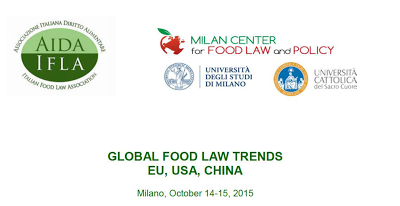
Seminar: Global Trends Food Law EU, USA, China

Professor Fortin will be speaking at the Global Food Law Trends EU, USA, China seminar in Milan, Italy, October 14-15. The agenda is available here

More information is available from: Prof. Ferdinand Albisinni University of Tuscia (VT) Via Ciro Menotti, 4 00195 ROMA Tel. 06.32.16.171 Fax 06.32.17.034

Wednesday, September 16, 2015

Careers in Food and Drug Law Webinar - No Cost

The Food and Drug Law Institute's Careers in Food and Drug Law webinar will be held on September 24 from 12:00 pm- 12:45 pm EST. The seminar is offered at no cost.

In addition to providing students an opportunity to hear from leading experts about career opportunities in food and drug lawthe panel will be answering questions from the audience during the session, as time permits. Please submit your career questions in advance to  


The webinar is free but registration is required. We would appreciate it if you would post, display, or email the flyer describing the event to students who would be interestedMore information can also be found on our website.

If you have any questions, please feel free to contact Kevin Newman at (202) 222 0897.

Institute for Food Laws and Regulations

Saturday, July 11, 2015

IFT 2015

For anyone attending IFT in Chicago, July 11-14, stop by the Michigan State University Global Food Law booth in the Expo and say hi. We are booth #1709.

Friday, May 15, 2015

Kresge Foundation has granted $150,000 to the MSU Food Law Clinic

The Kresge Foundation granted $150,000 to the MSU Food Law Clinic in Detroit, Michigan. Read the whole story here.

Wednesday, May 13, 2015

Global Food Law Program Graduates Its Largest Class

The first major cohort of students from Michigan State University College of Law’s Global Food Law Program will graduate Friday.
The College of Law commencement ceremony will be at 11 a.m. at the Jack Breslin Student Events Center. Because the Global Food Law Program is completely online, graduation is the only on-campus activity for the program.
Launched in 2012 in collaboration with MSU’s Institute for Food Laws and Regulations, the Global Food Law Program is the first and only global food law master’s degree program. It offers two tracks: a master of laws for practicing lawyers or those with a law degree and a master of jurisprudence for those without law degrees. There are currently 30 students from seven countries enrolled in the program.
The full story is here.

Tuesday, April 21, 2015

Margo Wootan speaking at MSU April 22: "Supporting Americans' Efforts to Eat Well and Watch Their Weight"

Dr. Margo Wootan will discuss "Supporting Americans' Efforts to Eat Well and Watch Their Weight".

Please join us in room 1135 S. Anthony Hall, Michigan State University, at 4pm on Wednesday, April 22nd.

Sunday, April 19, 2015

P. Vincent Hegarty Recognized with Outstanding Contribution by an Individual Award

The Michigan State University (MSU) Faculty Emeriti Association (FEA) recognized Professor Emeritus P. Vincent Hegarty with their prestigious Outstanding Contribution by an Individual Award. The Outstanding Contribution by an Individual Award recognizes a Faculty Emeritus/Emerita who continues to serve MSU and foster active engagement from other Faculty Emeriti in the MSU community.

Dr. P. Vincent Hegarty exemplifies this award in his role as a Professor Emeritus in the Department of Food Science and Human Nutrition. He is also the Founding Director of the Institute for Food Laws & Regulations at MSU

Saturday, March 28, 2015

New Online Global Food Law course: Agriculture Special Topics: Pesticides, Fertilizer, and Conservation

The Master Program Global Food Law has a new online course this summer:

Agriculture Special Topics: Pesticides, Fertilizer, and Conservation (LAW 566R)

Course Description
Students will learn about the regulatory framework related to two of the major inputs used by the agriculture industry – pesticides and fertilizers. They will look at the federal and state regulations covering the manufacturing, storage, and use of these products, safety issues, and conservation practices designed to minimize their impact to the environment. They will also look at enforcement issues and litigation involving pesticides and fertilizers.

Bradley Deacon is the emergency management and administrative law coordinator for the Michigan Department of Agriculture and Rural Development. He has undergraduate and law degrees from Michigan State University and spent a year studying in Germany on a Fulbright grant. Upon returning, he worked on the family farm until heading to Lansing in 1995 for a position in the Office of the Governor. Deacon served as the Department of Agriculture and Rural Development’s legislative liaison and regulatory affairs officer for six years, and has been in his current position since 2004. He works on emergency coordination and planning for all of the department’s programs and issues, including agro-terrorism; animal health; foreign animal diseases; pets and other animals in emergencies; food safety; food protection and defense; continuity of the food supply; invasive pests and plant diseases; agri-chemical security; emergency planning and bio-security at farms, fairs, and festivals; environmental hazard mitigation on farms; laboratory sampling; fuel shortages; emergency communications; and continuity of government.


Friday, March 06, 2015


Explore online graduate degrees in Global Food Law from the nation's premier food university, Michigan State University.

Apply now for the summer or fall semester at globalfood.law.msu.edu
  • Get the tools you need to navigate a rapidly changing industry.
  • Flexible online program for lawyers and food industry professionals.
  • Applied courses in global food law and regulation taught by expert MSU faculty and practitioners. 
Summer semester: Application deadline is April 1, 2015. Classes begin May 18.
Fall semester: Application deadline is June 1, 2015. Classes begin August 17.


Summer 2015 course offerings:
  • Agriculture Special Topics: Pesticides, Fertilizer and Conservation
  • Survey of Intellectual Property in Agriculture
  • Food Regulations in Asia
Full curriculum and course descriptions available at globalfood.law.msu.edu

Tuition is $950 per credit hour. M.J. students must complete a minimum of 26 credits to graduate. LL.M. students with a J.D. must complete 24 credits to graduate.

Ready to apply? Apply online at
globalfood.law.msu.edu/admission.

Questions? Please contact Andrea Besley, Global Food Law Program Coordinator, at foodlaw@law.msu.edu or 517-432-6963.


Through our M.J. program, food industry professionals who do not have a law degree gain an understanding of common legal and regulatory issues.
Through our LL.M. program, associate attorneys who are new to food law can quickly gain the background to research food law issues and at a flexible pace with convenient hours. Seasoned attorneys can both refresh their knowledge on substantive law topics and receive updates on developments in global food law. 


MSU College of Law Global Food Law Programs
648 North Shaw Lane, Room 364
East Lansing, MI USA 48824
foodlaw@law.msu.edu
 

Blog Archive

Twitter Updates

    follow me on Twitter